
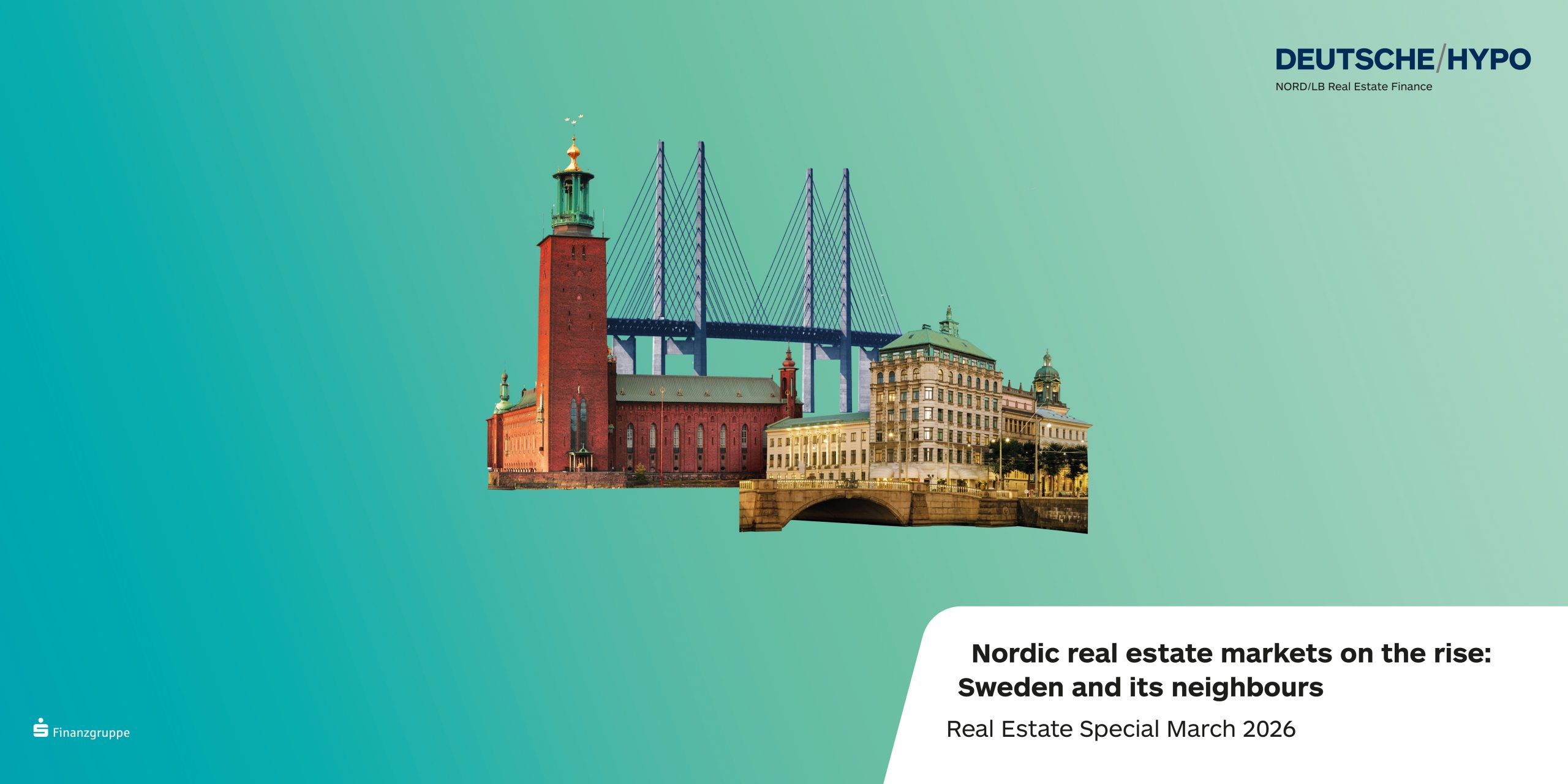
New study by Deutsche Hypo – NORD/LB Real Estate Finance highlights prospects for office, logistics and residential properties
After a challenging phase of correction, the Nordic real estate markets are returning to a stable growth trajectory. Sweden, in particular, is assuming a leading role within the region. This is one of the key findings of the new Deutsche Hypo study “Nordic real estate markets on the rise: Sweden and its neighbours”.
Driven by a robust economic recovery, lower interest rates and improved financing conditions, Sweden offers an attractive and comparatively low-risk environment for institutional real estate investors in 2026. High market transparency, political stability and a strong ESG orientation further enhance the country’s investment appeal.
“Sweden currently combines many of the factors that are decisive for long-term-oriented real estate investors: economic stability, high market quality and reliable regulatory frameworks,” says Ingo Martin, Head of Real Estate Finance Origination at Deutsche Hypo – NORD/LB Real Estate Finance.
Polarisation of Asset Classes – Focus on Quality and Sustainability
The study shows that while individual asset classes are developing differently, a common guiding principle is clearly emerging: quality, location and ESG compliance are increasingly determining market success.
The office market is highly polarised. High-quality, modern and sustainable space in central locations – particularly in Stockholm – remains in strong demand, recording rising prime rents and, in a European context, comparatively low prime yields. Older properties and peripheral locations, by contrast, are under structural pressure.
In the logistics segment, Sweden benefits from its role as a strategic hub in Northern Europe. Structural demand drivers such as e-commerce, nearshoring and defence logistics ensure a robust outlook despite temporarily elevated vacancy rates. Declining new construction activity is contributing to market stabilisation.
The residential real estate market remains the most stable asset class. Persistent supply shortages, particularly in metropolitan regions, are meeting strong demand driven by urbanisation and immigration. Very low vacancy rates and rising rents characterise the market, while prices are recovering moderately following the correction phase.
Conclusion: An Attractive Market with a Long-Term Perspective
The study concludes that Sweden and the Nordic real estate markets will be among the most stable investment locations in Europe in 2026. Solid macroeconomic fundamentals, high transparency and a consistent ESG focus support a continued market recovery and the sustainable strengthening of the region as a preferred destination for institutional investors.
This assessment is shared by Deutsche Hypo – NORD/LB Real Estate Finance, which also views Sweden as an attractive market. “The Swedish real estate market is characterised by an overall high quality,” says Ingo Martin. “It features stable, clearly structured framework conditions. Especially in the current market environment, such reliable structures are of particular importance for all market participants.”
Dialogue and Exchange at MIPIM 2026
An excellent opportunity for professional exchange on the Nordic real estate markets, as well as other European markets and current industry topics, is provided by the international real estate fair MIPIM, taking place from March 9 to 13, 2026 in Cannes. Deutsche Hypo – NORD/LB Real Estate Finance will be present at the German Cities & Regions Pavilion, exhibiting at a joint stand together with the City of Hanover, the Hanover Region, the City of Garbsen, ONE TechCampus Group and the commercial law firm KSB INTAX (Stand R8.D24).